Children’s educational posters are visual learning tools that help kids understand, remember, and review important ideas. They can teach letters, numbers, colors, shapes, science facts, classroom rules, daily routines, emotions, safety habits, and much more.
A good poster does more than decorate a wall. It gives children a quick visual reference they can return to again and again. In a classroom, homeschool room, bedroom, daycare, or playroom, the right poster can quietly support learning all day long.
This matters because children don’t all learn in the same way. The Universal Design for Learning framework encourages educators to present information in different forms so more learners can access it. Visual representation is one important part of that approach.
What Are Children’s Educational Posters?
Children’s educational posters are printed or digital displays designed to teach a specific idea in a visual format. They usually combine images, labels, short text, diagrams, symbols, colors, and examples.
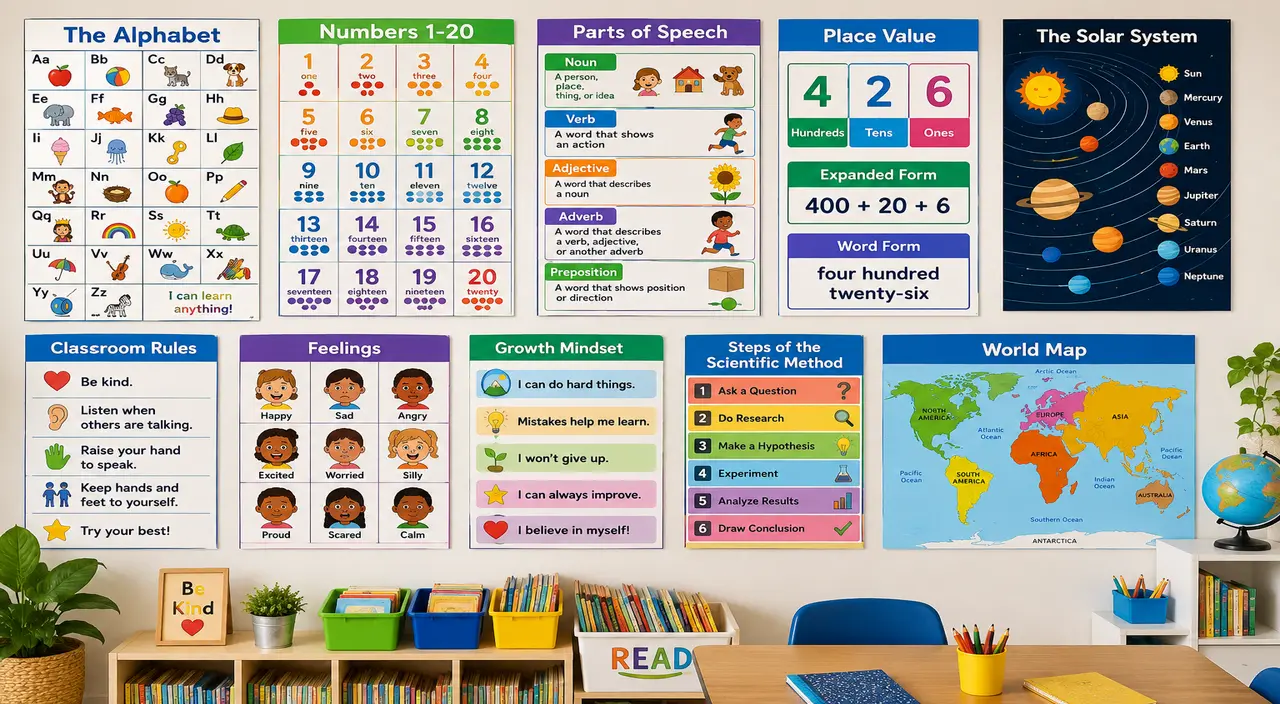
For example, an alphabet poster may show each letter with a picture: A for apple, B for bear, C for cat. A science poster may show the water cycle with arrows for evaporation, condensation, precipitation, and collection. A behavior poster may show children raising their hands, sharing toys, or using kind words.
The best educational posters are clear, focused, and age-appropriate. They don’t try to teach too much at once. Instead, they give children one strong learning message they can understand quickly.
Why Children’s Educational Posters Work
Educational posters work because they make learning visible. Children can look at them during lessons, transitions, playtime, or independent work. Over time, those repeated visual reminders can help ideas feel familiar.
Visuals Make Ideas Easier to Understand
Some ideas are hard for children to understand through words alone. A diagram, picture, map, or chart can make the idea much easier to grasp.
For example, explaining a volcano with only words can feel abstract. But a poster showing the magma chamber, vent, lava, ash cloud, and crater gives the child a clear picture. Suddenly, the lesson has shape.
CAST’s UDL guidance includes supporting multiple ways to perceive information and clarifying vocabulary, symbols, patterns, and relationships, which connects well with how strong educational posters are designed.
Posters Support Routines and Independence
Posters are not only for academic subjects. They can also help children follow routines.
A morning routine poster might show:
- Hang up backpack.
- Wash hands.
- Put lunch away.
- Sit on the carpet.
- Choose a book.
This kind of poster helps children know what comes next without needing an adult to repeat every step. NAEYC notes that visual supports can help children learn routines, stay engaged, and transition between activities.
Repeated Exposure Builds Familiarity
Children often need to see, hear, and practice ideas many times before they remember them. Posters support that repetition without making learning feel forced.
A child may not memorize shapes after one lesson. But if a shape poster stays on the wall for weeks, the child sees those shapes during play, cleanup, story time, and art activities. That steady exposure helps the information become familiar.
15 Types of Children’s Educational Posters
There are many types of children’s educational posters. The best choice depends on the child’s age, learning goal, and environment.
| Poster Type | Best For | Example Topic |
| Alphabet posters | Early literacy | Letters and sounds |
| Number posters | Early math | Counting 1–20 |
| Science posters | Curiosity and STEM | Solar system |
| Routine posters | Independence | Bedtime routine |
| Behavior posters | Social skills | Kind words |
1. Alphabet Posters
Alphabet posters are one of the most popular types of educational posters for kids. They help children recognize letters, connect letters to sounds, and build early reading confidence.
A strong alphabet poster should include uppercase letters, lowercase letters, clear images, and simple labels. For preschoolers, keep the design large and simple. For older children, you can add phonics examples, vowels, consonants, or beginning sounds.
2. Number Posters
Number posters help children recognize digits, count objects, and connect numbers with quantity. A number poster for young learners might show the number 5 with five stars or five apples.
The best number posters show both the symbol and the meaning. A child should not only see “7.” They should also see seven objects.
3. Shape Posters
Shape posters teach children to recognize circles, squares, triangles, rectangles, ovals, stars, hearts, and other shapes. These are especially useful when they connect shapes to real-world objects.
For example:
- Circle: clock
- Rectangle: door
- Triangle: slice of pizza
- Oval: egg
This helps children see that shapes are not just classroom ideas. They are everywhere.
4. Color Posters
Color posters are useful for toddlers, preschoolers, and early kindergarten learners. They help children name and identify colors.
A strong color poster should use clean color blocks and familiar objects. Avoid busy backgrounds because they can make the colors harder to see.
5. Science Posters
Science posters can turn complex ideas into simple visual lessons. They are excellent for topics like plants, weather, animals, space, volcanoes, rocks, magnets, and the human body.
A good science poster should be accurate and easy to follow. It should use labels, arrows, diagrams, and short facts.
6. Animal Posters
Children often love animal posters because animals are familiar, exciting, and easy to connect with. These posters can teach names, habitats, food chains, animal groups, and conservation.
Popular animal poster topics include:
- Farm animals
- Ocean animals
- Rainforest animals
- Dinosaurs
- Nocturnal animals
- Endangered animals
For ages 9–12, animal posters can include deeper facts such as size, diet, lifespan, habitat, and adaptations.
7. Math Posters
Math posters support skills children need to review often. They can show number bonds, addition facts, multiplication tables, place value, fractions, time, money, and measurement.
The best math posters include examples. A multiplication poster that only shows numbers may help memorization, but a poster with groups, arrays, or visuals can help understanding.
8. Reading Strategy Posters
Reading strategy posters remind children what good readers do. They are useful in classrooms, homeschool spaces, and reading corners.
Examples include:
- Look at the picture.
- Sound out the word.
- Reread the sentence.
- Ask what makes sense.
- Make a prediction.
- Retell the story.
These posters give children tools they can use while reading independently.
9. Grammar Posters
Grammar posters help children remember parts of speech, punctuation, capitalization, and sentence structure.
Good topics include:
- Nouns
- Verbs
- Adjectives
- Adverbs
- Punctuation marks
- Sentence types
- Synonyms and antonyms
For younger children, examples matter more than long definitions.
10. Classroom Rules Posters
Classroom rules posters help set clear expectations. They work best when they are positive and simple.
Instead of saying “Don’t shout,” say “Use a calm voice.”
Instead of “Don’t run,” say “Walk safely.”
Positive language tells children what to do, not only what to avoid.
11. Behavior Posters
Behavior posters support social-emotional learning. They can teach kindness, patience, sharing, listening, respect, self-control, and problem-solving.
A strong behavior poster should show the behavior clearly. For younger children, expressive characters and simple examples are especially helpful.
12. Routine Posters
Routine posters help children move through the day with less confusion.
Popular routine posters include:
- Morning routine
- Bedtime routine
- Cleanup routine
- Bathroom routine
- Handwashing steps
- Homework routine
- Classroom arrival routine
Head Start notes that visual supports can be printed and used to support young children’s development, participation, engagement, and learning.
13. Feelings Posters
Feelings posters help children name emotions. This is important because many young children feel big emotions before they have the words to explain them.
A feelings poster may include:
- Happy
- Sad
- Angry
- Worried
- Excited
- Tired
- Frustrated
- Calm
These posters are especially useful when paired with calm-down strategies.
14. Geography Posters
Geography posters help children understand the world around them. They can show continents, oceans, countries, landmarks, landforms, communities, and maps.
A map poster can become a conversation starter. A child may ask, “Where do we live?” or “Where is that animal from?” That curiosity is valuable.
15. Safety Posters
Safety posters teach practical life skills. They may cover fire safety, road safety, internet safety, playground safety, allergy awareness, sun safety, or emergency steps.
For young children, safety posters should be calm and clear. Avoid frightening images. Focus on simple actions children can remember.
How to Choose the Right Children’s Educational Posters
Not every poster is equally useful. Some look attractive but don’t teach clearly. Others contain too much text, tiny labels, or distracting graphics.
Here’s a simple way to choose better posters.
Match the Poster to the Age Group
A poster for a 3-year-old should not look like a poster for a 10-year-old.
| Age Group | Best Poster Style | Best Topics |
| Ages 2–3 | Big images, few words | Colors, animals, shapes |
| Ages 4–5 | Clear labels, simple examples | Alphabet, numbers, routines |
| Ages 6–8 | Short facts and visuals | Reading, math, science |
| Ages 9–12 | Diagrams and deeper facts | STEM, history, geography |
Check Readability
A poster should be easy to read from a normal distance. If the title, labels, or key points are too small, the poster will not work well on a wall.
Look for:
- Large title
- Clear font
- Strong contrast
- Short text
- Simple layout
- Enough white space
Confirm Accuracy
This is especially important for science, geography, history, grammar, and safety posters.
Before using or selling a poster, check:
- Are the facts correct?
- Are the labels spelled correctly?
- Are diagrams accurate?
- Is the information age-appropriate?
- Does anything look misleading?
A pretty poster with incorrect information is still a poor educational tool.
Where to Use Educational Posters
Children’s educational posters can work in many places.
Classrooms
In classrooms, posters can support lessons, routines, and behavior expectations. Use them in reading corners, math walls, science centers, writing areas, and morning meeting spaces.
Homeschool Rooms
Homeschool posters can help parents create a structured learning environment without needing a full classroom. A few strong posters can support daily lessons and independent review.
Bedrooms and Playrooms
Posters in bedrooms and playrooms can encourage casual learning. Animal facts, maps, alphabet charts, and bedtime routine posters work especially well in these spaces.
Daycare and Preschool Centers
In early childhood spaces, posters can help children understand routines and transitions. Visual supports are often useful because they help children know what to expect.
Common Poster Mistakes to Avoid
A poster can have a great topic and still fail because of poor design.
Avoid these mistakes:
- Too much text
- Tiny fonts
- Weak contrast
- Busy backgrounds
- Too many images
- Cluttered layout
- Poor spelling
- Incorrect facts
- Age-inappropriate vocabulary
- Confusing reading order
- Decorative elements that distract from learning
One thing many creators overlook is that a poster has to work from a distance. If it only looks good close up on a screen, it may not work well when printed and placed on a wall.
FAQs About Children’s Educational Posters
What are children’s educational posters?
Children’s educational posters are visual learning tools that use pictures, labels, diagrams, colors, and short text to teach children key ideas. They can cover letters, numbers, science, behavior, routines, safety, emotions, and more.
Why are educational posters useful for kids?
Educational posters are useful because they make learning visible. They give children repeated exposure to important ideas and can help them understand concepts, remember information, and follow routines.
What makes a good educational poster?
A good educational poster is clear, accurate, age-appropriate, readable, and focused on one main learning goal. It should use strong visuals, simple text, and a clean layout.
Are educational posters good for toddlers?
Yes, educational posters can be good for toddlers when they use large pictures, familiar objects, and very few words. Good toddler poster topics include colors, shapes, animals, body parts, and daily routines.
How many educational posters should be in a classroom?
There is no perfect number, but fewer high-quality posters are usually better than too many cluttered ones. Choose posters that support current lessons, routines, or behavior goals.
Can educational posters help homeschool learning?
Yes. Homeschool posters can support daily lessons, independent review, schedules, math facts, reading strategies, science topics, and routines. They are especially helpful when placed where children can see them often.
Should educational posters have a lot of text?
No. Posters should use short, clear text. Too much text can overwhelm children and make the poster harder to use. Pictures, labels, arrows, and examples are usually more effective.
What size should educational posters be?
Common sizes include letter size, A4, 11 x 14 inches, 16 x 20 inches, and 18 x 24 inches. Larger posters work best for walls, while smaller posters work well for binders, folders, and learning centers.
Conclusion
Children’s educational posters are simple but powerful learning tools. They help children see important ideas, review key concepts, follow routines, and build confidence. When designed well, they can support literacy, math, science, behavior, emotional learning, safety, and everyday independence.
The best posters are not the busiest or brightest. They are the clearest. They use strong visuals, readable text, accurate information, and age-appropriate design.
Whether you are a parent, teacher, homeschooler, or educational product creator, children’s educational posters can turn ordinary walls into helpful learning spaces.