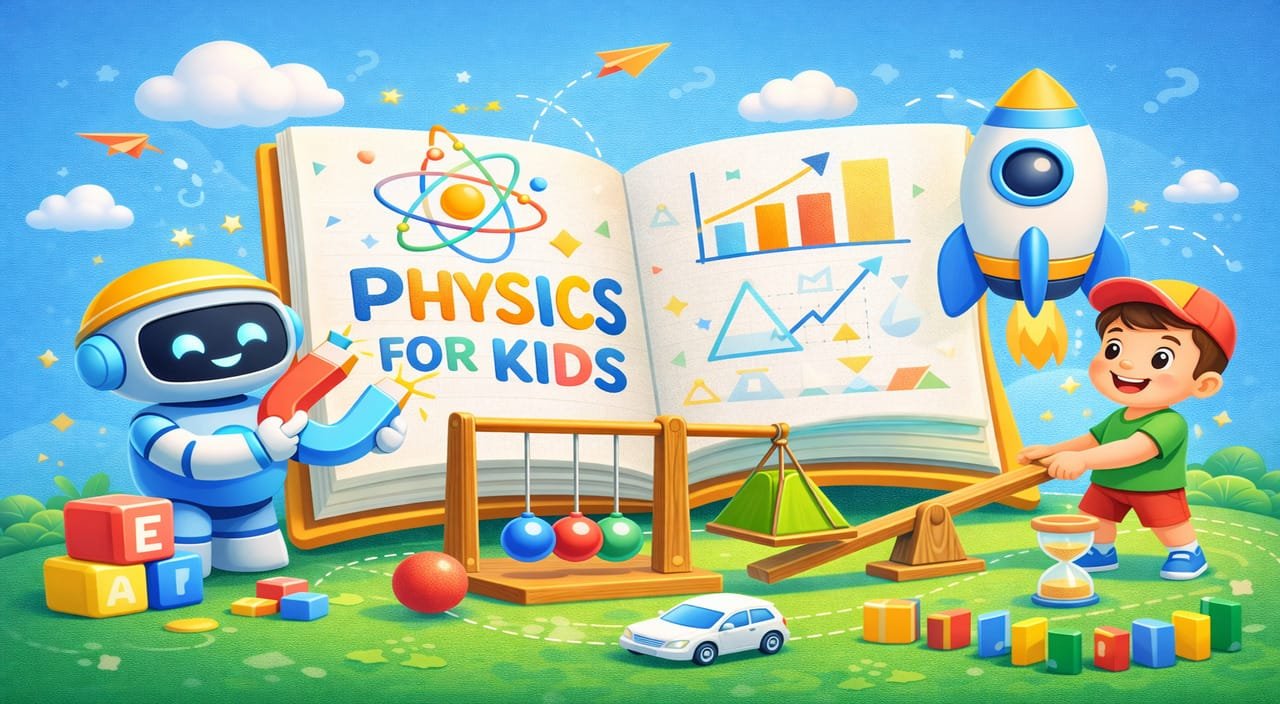
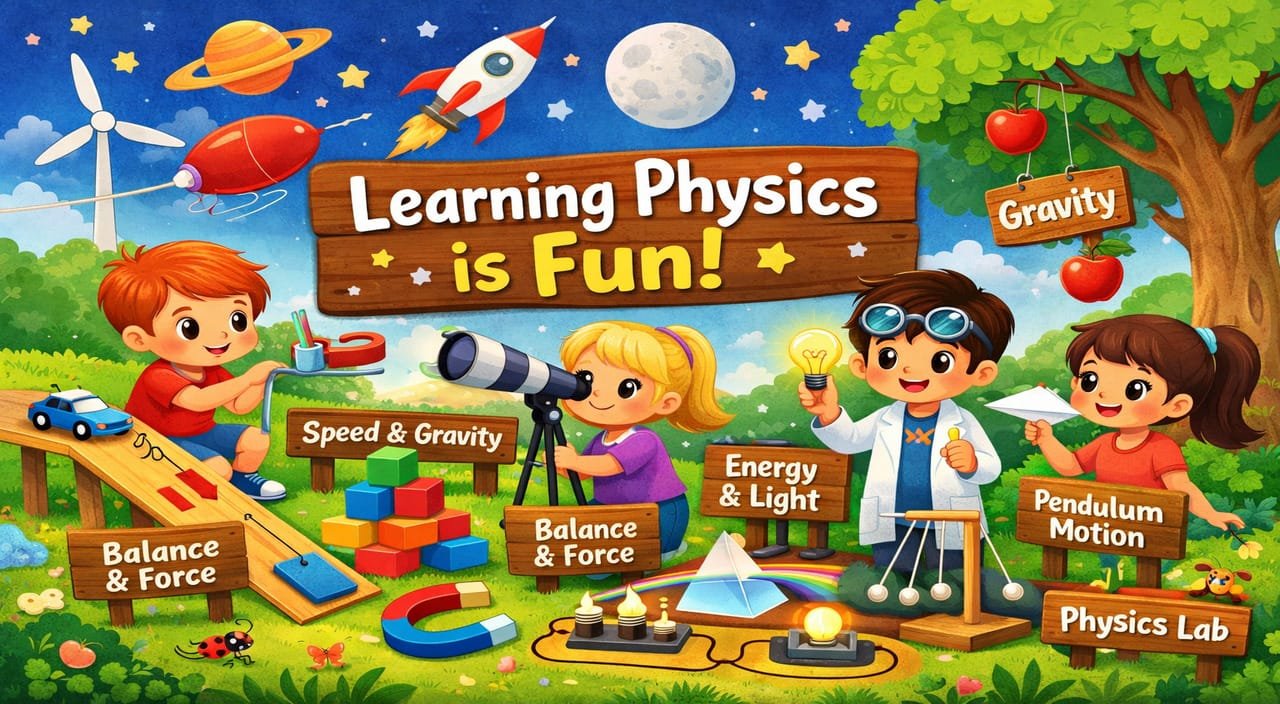
The notion that physics belongs exclusively to laboratories and lecture halls is a myth wrapped in intimidation. Children, in truth, are already amateur physicists. Every dropped spoon, every spinning top, every question that begins with “Why did that happen?” is an inquiry into the architecture of the universe. Physics is not an elite dialect reserved for scholars—it is the quiet grammar of existence itself.
When a child rolls a toy car across the floor or stacks blocks into a precarious tower, they are not merely playing. They are interrogating gravity, friction, equilibrium. They are rehearsing the language of force and motion long before they can define those words.
Early immersion does not overwhelm the young mind; it fortifies it. Curiosity, once ignited, seldom extinguishes.
The Bedrock of Physics: Ideas That Shape Reality
Physics concerns itself with the elemental scaffolding of reality—matter, energy, motion, interaction. It is the study of how the cosmos conducts itself.
A child who observes a ball accelerating downhill is witnessing motion governed by invisible directives. When they notice that heavier objects resist being pushed, they are brushing against the concept of inertia. These are not esoteric abstractions. They are lived experiences, translated later into vocabulary.
Gravity choreographs falling leaves and orbiting moons alike. Light streaks across space in disciplined waves. Sound trembles through air molecules, carrying laughter and thunder with equal indifference. The laws of motion dictate why a skateboard glides and why it halts.
Energy, meanwhile, is the great shapeshifter—thermal, kinetic, electrical—perpetually exchanging attire but never vanishing. Momentum predicts collisions before they occur. Physics, in essence, narrates the behavior of everything that exists.
Why Physics Anchors the Sciences
Physics is the spine upon which other sciences hinge. Chemistry borrows its rules of atomic interaction from it. Biology relies on it to explain nerve impulses and muscular motion. Astronomy would be mute without it.
The smartphone resting in a child’s hand is a quiet symposium of physical principles—optics, electromagnetism, quantum mechanics. Automobiles move because forces cooperate in disciplined alignment. Aircraft defy gravity not by rebellion, but by obeying aerodynamics with precision.
From renewable energy systems to advanced medical imaging, physics serves as the silent architect. To introduce a child to physics is to hand them a key—one that unlocks not just formulas, but comprehension of the modern world.
Physics in Daily Rituals
Physics does not announce itself. It simply operates.
A swing arcs in pendulum rhythm. A slide illustrates the negotiation between gravity and friction. A magnet tugs at metal with invisible insistence. Even the act of opening a jar invokes torque and rotational force.
Household objects double as teaching instruments. A ramp becomes a lesson in acceleration. A pulley turns into a revelation about mechanical advantage. The ordinary, when examined attentively, becomes extraordinary.
Children do not require laboratories to learn physics. They require permission to notice.
Translating Complexity for Young Minds
The secret to teaching physics to children lies not in dilution, but in translation. Grand theories must be rendered in tangible experiences.
Inertia can be explained through a toy car that continues rolling after a push. Static electricity reveals itself when a balloon clings mischievously to a wall. Magnetism introduces invisible forces without intimidation.
Language should be lucid but not patronizing. Short explanations. Vivid analogies. Concrete examples anchored in the child’s lived reality.
By layering understanding gradually—like bricks forming an arch—you construct durability rather than confusion.
Experiments That Spark Intellectual Fire
Children comprehend most deeply through participation.
A balloon rocket streaking across a string dramatizes force and motion. Paper airplanes transform air resistance from abstraction into competition. A homemade pendulum demonstrates gravity’s patient consistency.
Bubbles refract light into spectral ribbons, quietly introducing optics. Simple circuits powered by small batteries illuminate the choreography of electrons.
Such experiments do more than teach content. They cultivate observation, hypothesis, refinement. The child begins to ask not only what happened, but why.
That shift—subtle yet seismic—is the birthplace of scientific literacy.
The Titans of Physics
History remembers certain minds not because they memorized equations, but because they dared to reinterpret reality.
Isaac Newton articulated the laws of motion and universal gravitation, forging the bedrock of classical mechanics.
Albert Einstein unsettled conventional thought with relativity, entwining space and time into a singular continuum.
Galileo Galilei peered through improved telescopes and insisted that observation outranked assumption.
Marie Curie illuminated radioactivity, expanding the boundaries of atomic science.
Niels Bohr reshaped our understanding of atomic structure through quantum modeling.
These figures were once children who asked inconvenient questions.
To introduce their stories to young learners is not merely historical enrichment—it is an invitation. An assurance that inquiry can alter the trajectory of civilization.
Bridging Yesterday’s Discoveries with Today’s Learning
Historical breakthroughs need not remain confined to textbooks. Drop two objects to examine gravitational acceleration. Build a pendulum and observe periodic motion. Bend light through a prism and witness refraction firsthand.
Modern simulations and interactive platforms extend these lessons beyond physical materials. They allow children to manipulate variables, test predictions, and visualize the unseen.
The lineage from Newton to a child experimenting in a kitchen is not distant. It is direct.
Advancing Physics Education Thoughtfully
Progression is essential. Begin with motion, force, and energy—the sturdy pillars. Introduce complexity incrementally. Encourage problem-solving over memorization.
Invite children to form hypotheses. Allow them to be mistaken. Correction, in science, is refinement—not failure.
Technology can supplement learning, but tactile experience remains irreplaceable. The mind comprehends best when the hands are engaged.
Most importantly, cultivate intellectual audacity. A child unafraid to question is a child already participating in physics.
Frequently Asked Questions
What age is appropriate to begin physics education?
Foundational ideas can be introduced as early as five or six through experiential play. Complexity should evolve in tandem with cognitive maturity.
Which teaching methods resonate most effectively?
Experiments, storytelling, analogies, and real-world illustrations yield superior engagement. Abstract formulas should follow comprehension—not precede it.
How can parents nurture sustained interest?
Model curiosity. Explore together. Visit science museums. Read biographies of physicists. Transform “Why?” into a collaborative investigation rather than a dismissal.
Are there accessible experiments for home environments?
Certainly. Explore density with layered liquids. Construct simple levers. Observe static electricity with balloons. Even cooking can demonstrate heat transfer.
Which foundational concepts deserve early attention?
Motion, gravity, friction, energy, light, and simple machines compose a durable introduction.
How do educational standards shape instruction?
Curricular frameworks often determine sequencing and depth, ensuring age-appropriate exploration while maintaining conceptual continuity across institutions.
Closing Reflection
A child does not require advanced calculus to begin understanding physics. They require wonder. They require opportunity.
Physics is not an intimidating fortress—it is the underlying melody of existence. When introduced early, through play and exploration, it ceases to be abstract. It becomes intimate.
And perhaps the most profound lesson is this: the universe is not distant. It is unfolding constantly—in falling leaves, in bouncing balls, in the quiet persistence of gravity.
All a child must do is look closely.