The Universe’s Secrets
The universe is vast and beckons us with its enigmas. There are more stars in the sky than sands upon the Earth’s beaches. Now, Earth, our home, would fit into the sun 1.3 million times, emphasizing how insignificant our planet really is.
Space is full of secrets, from Mercury’s day being longer than its year to Pluto’s demotion into a dwarf planet. Even the Moon molds life, making tides and waves. When the Moon passes between the Earth and the Sun, sunlight is blocked and a solar eclipse occurs.
This event scared Emperor Louis of Bavaria to death in 840 AD. These facts illuminate the size and mystery of the universe, providing an excellent foundation for any physics adventure.
1. Pushes and Pulls
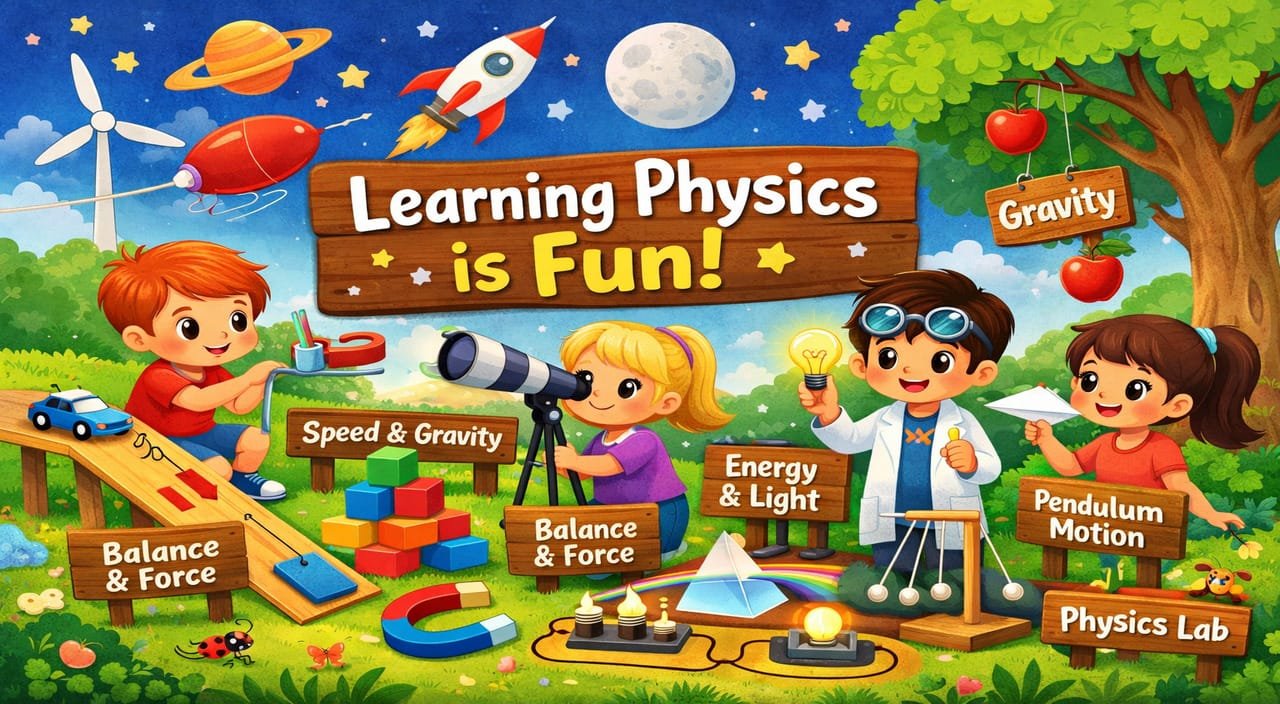
Forces start or stop motion, and these are frequently merely pushes or pulls. When you give a swing a push or pull open a door, you’re applying force. Kicking a ball or riding a bike are simple, common examples of observing how a push or pull alters motion.
You can attempt to roll a toy car or drop a ball to observe the forces in action. Observing these shifts connects what we learn to what we live.
2. Things in Motion
Motion concerns the movement of objects from one location to another. Not only does speed matter, but direction does too. A speeding car, a bike turning, or a falling apple all demonstrate motion.
Attempt to catch something whizzing around you and narrate your observations. Velocity is speed with a direction. Acceleration is speeding up or slowing down.
3. Energy Everywhere
Energy is what gets things done. Kinetic energy is in a bouncing ball, potential is in a stretched rubber band. Try dropping a ball and watch energy shift form from potential to kinetic.
Energy runs our lights, computers, and toys. Discovering all about solar or wind energy can ignite questions on how to keep our world working in the future.
4. Light and Sound
Light and sound are central to how we see and listen. Light allows us to see colors and cast shadows. Sound moves in waves, such as a song or a vocal.
Light a flashlight or clap your hands to watch and listen to energy flow. Consider your daily employment of light and sound.
5. Tiny Particles
Atoms and molecules are all there is. They’re too tiny to see, but they construct everything, from the air and water to our own bodies. Simple models could demonstrate how atoms combine to create new objects.
The universe of minutiae is bizarre. Black holes have gravitational pull so powerful that light cannot even break free, and the nearest one is some 10,000 light years off.
Key Takeaways
- Physics concepts can be made accessible and engaging for children through hands-on experiments, relatable examples, and step-by-step explanations that simplify abstract ideas.
- Inspiring curiosity and critical thinking aids kids in cultivating a fascination with exploring how unseen forces such as gravity and magnetism influence the world around them.
- Cooking, playing on the playground, or with water can be a great and safe way for us to explore science!
- By presenting fundamental concepts like energy, motion, and particles through imaginative pictures and narratives, we cultivate a deep grounding in physics for kids.
- Deconstructing large numbers and complicated units of measure with silly analogies and relative comparisons helps make large scale scientific concepts huggable.
- By encouraging curiosity at all ages through available resources and hands-on activities, you promote self-confidence and lay the groundwork for future scientific and physics exploration.
Physics for kids is about explaining the fundamental laws of the universe, such as motion, gravity, and acoustics, in an easy and entertaining manner.
Children understand the world by posing questions and experimenting with hypotheses. With interactive games and simple language, children observe how light, force, and energy operate around them.
The following sections provide actionable advice to get kids started with physics.
Everyday Magic
Everyday magic is discovering science in the world around us, turning learning into a fun, hands-on adventure. Calculus isn’t only in lecture halls and lectures—it’s in comic books and on kitchen tables. When kids experience science in the world around them, they learn to ask why things work, and this curiosity forms robust problem-solving skills.
With everyday items, any parent or caregiver can deconstruct difficult ideas like gravity or buoyancy into light, enjoyable classes. Whether it’s for elementary, junior high, senior high, or even secular homeschoolers, science is now accessible to all.
Kitchen Science
The kitchen is ideal for down-to-earth experiments. Baking bread or pancakes demonstrates chemical reactions in action. Yeast and baking powder cause dough to rise, transforming invisible gases into fluffy delights.
Combine vinegar and baking soda, and you have fizzing bubbles, which is a great way to demonstrate how acids meet bases. Kids can guess, observe for variation, take notes on what they observe, and learn science by doing and observing.
Checklist for Kitchen Experiments:
- Watch dough rise. See how gas forms bubbles in bread.
- Mix vinegar and baking soda. Observe how bubbles and foam form.
- Test floating eggs: Add salt to water and see if eggs float.
- Measure how fast ice melts. Try placing it on different surfaces or adding salt.
Tinkering with ingredients, temperature or timing helps kids understand how little adjustments alter outcomes. This creates anticipation and gets children connecting stove-top play with actual physics concepts.
Playground Forces
Playgrounds are full of things in motion, so they’re excellent venues to detect physics in action. Swings demonstrate how gravity pulls and momentum keeps going. Slides demonstrate how friction decelerates you, and merry-go-rounds emphasize how forces twist and turn in circles.
Kids can race matchbox cars, roll balls, or even use stop watches to measure speed and distance. Group activities, such as determining who can swing the highest or descend the slide the farthest, educate on collaboration and statistics.
Challenging like timing how long it takes to swing back and forth or measuring how far a ball rolls helps ground abstract concepts in real life. These group games enhance both learning and social skills.
Bathtub Discoveries
Bath can become a science lab. Kids can experiment with objects to see if they sink or float, teaching them about density and buoyancy. Plastic ducks bob on the surface, but metal spoons drop to the bottom.
Pushing toys under demonstrates water pressure and resistance. Pouring water from various heights demonstrates how the force of motion transforms the shape of the splash.
Kids could wonder why the soap foams or why they float better in salt water. Investigating these inquiries in a fun manner ignites crucial contemplation and keeps education new and thrilling.
Hands-On Exploration
Hands-on exploration, active learning, can open kids’ eyes to the physics all around them. When kids get hands-on by constructing, experimenting, and discovering, they develop their curiosity and confidence. It facilitates problem solving and helps make dense subjects more digestible. A few no-fuss experiments with everyday objects, a penny, a paperclip, a balloon, call out to kids everywhere to come along, no matter their background or means.
Hypothesizing and experimenting, even when outcomes surprise their guess, cultivates grit and scientific thinking.
Gravity Drops
Drop two things, like a wooden block and a paper ball, from the same distance. See how they both hit the floor and feel how air resistance and shape change the speed. Experiment with objects of various weights or forms and record your observations.
Ask kids to predict, “Will a heavy coin or a feather drop faster?” Have them put these guesses to the test and discuss why. Touch upon something you encounter every day, like how gravity pulls you back to the ground after a jump or why a dropped ball bounces.
These easy steps bring gravity tangible and apparent.
Magnet Mazes
Slide a small metal novelty beneath a sheet of paper and manipulate it magnetically. Hands-On Exploration – Construct mazes with cardboard and have kids navigate a paperclip through the turns with their magnet from underneath. Demonstrate how certain items adhere to the magnet and others do not.
Have them create their own maze, morphing shapes to stump friends or family. Connect this to real life and discuss how magnets are utilized in electric motors, speakers, and trains. In this manner, magnet play becomes a lesson in force and invention.
Boat Building
Give children tin foil, plastic bottles or straws to build a boat. Fill a bowl with water and test to see which design floats the best. Others might sink if too much weight is added or if the design is too one-sided.
Explore hands-on why wide, flat boats like to float on top, while thin shapes might tip. Allow children to experiment with various weights and shapes, motivating them to collaborate in pairs or groups to solve floating puzzles.
This hands-on work helps foster collaboration and allows them to experience iterative ideation as they build and repair.
Shadow Puppets
Flashlight on a wall, use your hands or paper or cutouts and make shadows. Bring the light closer or away from you to vary the shadow’s size. They could create their own puppets and tell stories, shifting the shadows with every movement.
Question why shadows expand or contract and what occurs if you increase the illumination. Bring in science by discussing light sources, the straight path of light, and why certain objects block light. By playing, children observe how light and shadows interact.
Common Stumbling Blocks
Physics is hard for kids because it requires them to make sense of what they can’t always see, count, or touch. Non-obvious factors, large quantities, and general concepts can derail even the most enthusiastic learner. A few children have difficulty with friction’s orientation or visualizing gravity. Some of my other students have trouble with motion laws or energy. They’re all typical stumbling blocks, and the proper strategy will assist children in overcoming them.
Invisible Forces
Invisible forces such as gravity and magnetism are tricky because we cannot see them, only feel or observe their effects. Children might struggle to envision why a dropped ball falls or why magnets attract or repel. Friction, yet another unseen force, can be tricky. Children frequently get muddled with which way it acts.
- Gravity
- Magnetism
- Friction
- Air resistance
- Electric force
Simple experiments bring these forces to life. Dropping various objects to demonstrate gravity or rubbing a balloon on hair to illustrate static electricity allows children to visualize unseen forces. Have kids think about how magnets stick to the fridge or why shoes stick to the floor. This helps develop critical thinking about invisible forces influencing the world.
Big Numbers
Physics uses numbers so large or small that they seem unreal. Distances between planets or the speed of light are tough for kids to imagine. To de-frighten these figures, use examples they’re familiar with. For instance, if you take the distance to the moon, it is equivalent to walking around the world 10 times.
Sometimes drawing or stacking blocks to represent large sizes or long distances can assist. Games incorporating measuring tapes or stopwatches allow children to experiment with speed and distance, cultivating confidence with numbers.
Abstract Ideas
Abstract physics concepts, such as energy or Newton’s third law, are difficult to understand. Kids require steps to break these down.
- Start with a simple, real-world example.
- Show the idea with a hands-on activity.
- Have kids sketch or construct a model of what they observe.
- Repeat, letting them try again with new examples.
By having kids either sketch out trajectories or construct basic models, you transform these abstract concepts into visual or tactile representations. Tell them that physics is something you learn over time with practice. Blunders of budding intellects.
Beyond the Basics
Physics isn’t about fact-learning. It’s about challenging ideas and asking new questions. Children that explore physics develop acute cognitive abilities, discovering to peer further at why things function. It’s a realm of unseen forces — energy, gravity — forming all things, from atoms to galaxies.
Even trivial acts — stacking boxes, hitting a ball — uncover fundamental natural laws. These concepts get children thinking deeply and observing how science fits into everyday life. Just as scientists, or physicists, pose daring questions and advance our understanding of the universe.
The table below shows some advanced concepts and questions that can spark curiosity:
| Concept | Key Question | Real-World Example |
|---|---|---|
| Conservation of Energy | How does energy move or change? | Solar panels turning sunlight to power |
| Relativity | Does time pass the same for everyone? | GPS satellites needing time correction |
| Wave-Particle Duality | Can light act as both wave and particle? | Lasers, camera sensors |
| Gravity | Why do things fall? | Planets orbiting the sun |
| Black Holes | What happens at the edge of a black hole? | Space telescopes observing star collapse |
Quantum Leaps
Quantum physics looks at things smaller than atoms. It’s not like real life. Things don’t have to be black or white, or either/or. Below is a table to show the basics:
| Principle | Example |
|---|---|
| Superposition | A coin spinning, both heads and tails at once |
| Entanglement | Two dice rolling together, always matched |
| Uncertainty | Not knowing both speed and spot of a ball |
This field asks us to think: can things really be in two places at once? What does it imply for reality if the world is this weird at heart?
Superposition is akin to a coin spinning in the air, simultaneously heads and tails until you catch it. Entanglement connects objects so that what happens to one impacts the other, even at great distance.
Cosmic Questions
Kids have big questions: how did the universe come to be? Are we by ourselves? Black holes, stars, and planets all begin with these basic questions. Astronomy, a branch of physics, lets kids look up and wonder.
It drives us to discover and seek our location in the universe. Stars are enormous spheres of incinerating gas. Black holes have gravity that is so powerful that nothing can escape.
They use telescopes to discover new worlds and possibly even traces of life.
Nurturing Curiosity
Curiosity is the root of learning physics for kids. Kids are born to observe, question, and seek out explanations for the way the world operates. This sense of wonder is near to what researchers do daily. Teachers and adults can help this grow by demonstrating how to observe, inquire, and record like real scientists.
By demonstrating how to identify patterns, gather basic facts, or think out loud, adults provide kids with a concrete road map. Supplying kids with the appropriate things to work on has a huge impact. Balls, magnets, or even old boxes can trigger questions about motion, force, or balance.
When kids employ these to attempt, fail, and attempt again, they learn so much more than content. They discover that errors are okay and every failure can educate them. It’s useful to maintain a log—sketching, journaling, or even taking micro-video clips—so that both educators and children can reflect later on what was effective or what was peculiar.
This type of record not only helps everyone observe their process but also develop more robust concepts for next time. Questioning is the primary instrument of juveniles. Questions prime the pump for more profound conversations and introduce new vocabulary that labels what they observe and believe.
If your kid asks why a ball rolls fast on the hardwood floor but slow on a rug, teach them new words like friction or speed. Teachers can participate as fellow explorers, collaborating with kids to sustain the conversation and discover new things together. This collaboration makes science a communal adventure.
Conclusion
Kids learn best by observation, action, and inquiry. Physics explains how stuff works, from a bouncing ball to light filling a room. Magnets and a glass of water—simple tools can ignite huge ideas. Grown-ups and teachers assist immensely when they allow children to attempt and screw up, then attempt again. Sometimes it feels hard, but tiny victories develop actual skill. Crystal steps and candid conversation keep us all on track. So let kids keep poking at things, keep asking why, and keep testing what they see. Physics isn’t just for a test or a grade; it helps kids understand the world. Tell me a cool new thing you learned today or do an experiment soon.
Frequently Asked Questions
What is physics for kids?
Physics for kids is an easy way to teach how nature works. It explores subjects such as motion, energy, and forces with simple explanations and interesting activities.
Why should children learn physics?
Physics for Kids: Learning that will help you understand the world around you. It inspires curiosity, enhances problem-solving abilities, and lays the groundwork for future scientific endeavors.
How can kids explore physics at home?
Kids’ physics lets you learn physics through hands-on experimentation. Basic experiments, such as dropping items to determine which falls quicker, teach them about gravity and motion in a safe home environment.
What are common challenges when learning physics?
Kids can struggle with physics if it appears to be abstract. By employing real-life examples and hands-on experiments, these concepts become easier to comprehend.
What basic physics topics are best for beginners?
Great starter topics are gravity, light, sound, and simple machines. All these are simple to observe and experiment with using common objects.
How can parents support their child’s interest in physics?
Parents can foster an inquisitive attitude, give easy experiment kits, and expose them to physics books or videos. Building a can-do learning environment ignites curiosity and confidence.
Can learning physics help with other school subjects?
Yes, physics indeed underpins math and analytical and problem solving skills. Knowing physics aids in areas such as chemistry, engineering and environmental science.