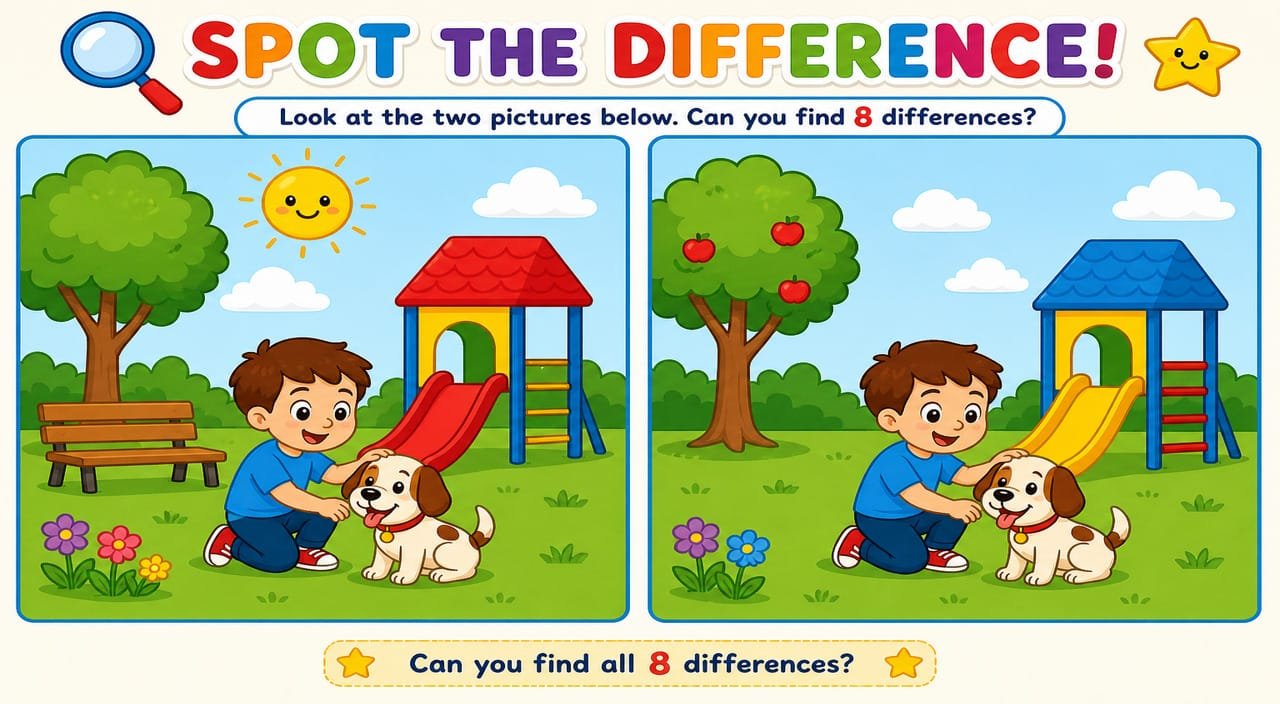
The “Kids Spot the Difference” printable consists of pairs of pictures with slight changes between them to aid children in developing observation and concentration.
These printables cover everything from easy two-item differences for preschoolers to more complex scenes for older children. They support visual scanning, detail attention, and vocabulary when combined with prompts.
Parents and teachers can select level, theme, and format to suit age and learning objectives in the classroom or at home.
Key Takeaways
- These spot-the-difference printables are a great, low-tech brain workout for kids to build observation, concentration, and problem-solving skills. They provide a much-needed screen-free option for families and classrooms.
- Utilize age-appropriate difficulty and distinct design elements like color shifts, missing items, and size changes to align with developmental stage and maintain kids’ enthusiasm.
- Provide a range of thematically focused printables featuring day-to-day scenes, nature and fantasy themes, and holidays to increase relevancy, maintain interest, and connect puzzles to real-world learning.
- Print your printables well. Card stock is best. Give the kids pens or markers. Keep the answer sheets away and file the puzzles in a binder for reuse!
- Foster scaffolded play and progressive challenge by demonstrating search strategies, timing round attempts, using hints judiciously, and alternating difficulty to cultivate confidence and grit.
- Mix and match printables and digital to take advantage of interactive bells and whistles for variety while keeping printables as a take-along soothing activity for trips, quiet time, and cooperative play.
The Hidden Power
Spot the difference printables open a magical, cheap portal to accessing the hidden power that lies within children and classrooms. These puzzles provide an express lane to hone perception and unlock hidden powers, which others refer to as subconscious strengths or hidden potential, by compelling kids to decelerate, survey, and contrast.
The mere search for small shifts conditions attention and patience. It can surprise you with hidden reserves of observation and persistence that lie dormant in our otherwise screen-saturated, hyper-accelerated habits.
Cognitive Boost
Difference games stretch memory, attention, and decision-making in intense, repetitive cycles that seem like fun but act like exercise. By trying to find differences between two nearly identical images, short-term visual memory is compelled to maintain features while the eyes scan the page, improving working memory capacity in small, quantifiable increments.
When children judge whether a feature is identical or modified, they engage in reasoning and categorical filtering, which are fundamental types of problem-solving that translate directly to subsequent abstract work. Such repeated exposure makes the mind faster and better at pattern matching.
Kids become faster at spotting anomalies and are less likely to overlook subtle signals. Use printable sheets in class rotations or short home sessions to make the gains routine. Five minutes after lunch or during transition times yields steady improvement without heavy prep.
Visual Skills
Spot the difference games exercise visual discrimination and fine-grained attention to hue shifts, flipped objects, or items added or removed. As your eyes learn to catch nuances of color and object orientation, you become better at parsing a scene, which feeds everything from map reading to code review.
Printable sheets offer a controlled visual field and therefore allow teachers and parents to easily scale difficulty by increasing the number or subtlety of differences, making them applicable from early childhood through preteens. Integrate them with early reading exercises.
Recognizing shape differences and letter-like parts builds the same neural habits used when decoding words and patterns.
Emotional Growth
Finding all differences gives clear feedback: success follows effort, which builds confidence and a sense of mastery in small, reliable doses. Here’s a short table with emotional growth types underpinned by puzzle work.
| Emotional Area | How puzzles help |
|---|---|
| Confidence | Clear wins reinforce self-belief |
| Patience | Slow scanning trains tolerance for delay |
| Frustration tolerance | Retrying fosters persistence |
| Social bonding | Cooperative solves improve connection |
Collaborative play transforms individual work into communal success, bonding friendships and role-modeling joint computation. Holiday-themed printables increase motivation and build positive associations around concentrated work.
When we get them in groups, they all tend to show different strengths. This emphasizes the peer dynamics and hidden power they have on a team.
Perfect Puzzle Printables
Perfect puzzle printables are a wonderful, no-cost, no-hassle resource for parents and teachers who want pre-made activities that educate and entertain. These combine two near-identical images with small differences, usually six per puzzle, to exercise visual discrimination, detail-oriented skills, and problem-solving.
They work across settings: rainy afternoons, travel, classroom stations, morning work, brain breaks, or quiet time. Opt for those that have solution sheets to make self-checking a breeze and promote independent learning.
1. Age & Stage
Pick puzzles with the right level of complexity and differences for your child’s developmental age. Preschool and kindergarten students like simple scenes with large shapes and less variation, whereas older children can take on more complex details and small variation.
A quick reference table organized by age group is as follows: Preschool (3–5 years) includes 3–4 differences with large shapes; kindergarten (5–6 years) includes 4–6 differences with medium detail; grade 1 (6–7 years) includes 6 differences with fine detail. This helps staff and parents pick quickly.
Just right matching keeps kids challenged but not frustrated and facilitates consistent skill development.
2. Theme & Interest
Offer a range of themes to boost motivation: animals, ocean scenes, space, or everyday playgrounds. Customize to known interests—unicorns, pirate ships, cupcakes—to get them to take a crack at the next level up.
Arrange printables thematically in a catalog or grid for educators to locate age-appropriate material quickly. Seasonal themes such as Valentine’s Day, Halloween, and Easter keep material fresh, and it is easy to plan event-based lessons or holiday centers.
3. Design & Detail
Beautiful images with obvious and not-so-obvious differences. Include color and black and white versions to fit ink budgets and provide coloring as an extra activity.
Include a mix of different types: missing items, color shifts, size changes, and added objects, so puzzles train multiple perceptual skills. Include a star or difficulty rating for each puzzle.
A quick reminder like this cuts down on the guesswork when picking puzzles for groups with mixed abilities.
4. Printing & Prep
Print on regular 80 to 120 gsm paper or card stock for long-lasting repetitive use. Provide pencils, markers, or crayons for circling differences right on the page.
Print solutions on separate sheets and keep them out of sight to avoid peeking. Maintain file folders or a binder with age and theme dividers so you can grab a puzzle in a pinch for any occasion.
5. Guiding & Playing
Parents should model the first few puzzles to demonstrate close-looking strategies and to establish the rhythm. Add a challenge and track progress over time with a timer.
Promote collaboration by matching up students for collaborative gameplay and conversation training. Provide hints and answers sparingly. Give a few tries before you provide answers to instill persistence.
Beyond The Page
Digital editions take this printable idea to phones, tablets, and computers, offering kids fresh ways to tackle spot-the-differences. These editions are fast-loading, screen-sized scalable, and typically feature several difficulty settings so a 5-year-old and 12-year-old can play the same title and have different experiences.
Play at home, in class, or on the move—a parent can load a quick round on a phone during a commute, and a teacher can project a longer scene on a tablet for group work. Digital files reduce paper consumption and enable designers to incorporate more vibrant graphics, animated components, and timed rounds that are more difficult to reproduce on paper.
Interactive elements transform the way kids engage with these brainteasers. Hint buttons direct attention without revealing the answer, which allows learners to practice effective search strategies. Timing bars provide just enough pressure to condition quickness and astute decision-making.
You can even calibrate them to track your progress between sessions. Mouse cursor and touch heatmaps show parents and teachers where a child looks or taps most, providing insight into attention. Those metrics assist in adapting difficulty and pinpointing areas where a child might need more practice with visual discrimination or fine-motor control.
Employ online games as an add-on to printed sheets to open up access and maintain diversity. Alternate formats within a lesson plan: start with a printed two-image pair to teach the basic method of comparing details, then move to a tablet game that introduces moving elements or partial occlusion.
Provide printable worksheets for silent, low-tech practice and save online rounds for reward play or data gathering. This blend accommodates various learning styles and keeps things available for device-incomplete classrooms, yet still allows device-complete homes to add intensive content.
Through themed categories and stage-based pattern matching, you can take the experience beyond single puzzles. With theme packs—animals, space, daily life, and cultural festivals—educators can tie visual tasks to curriculum topics like vocabulary or social studies.
Stage pattern matching games build a progression: early stages focus on color and shape changes; later stages add mirrored differences, rotated items, and occluded parts. Designers and teachers can use theme and stage mixes to scaffold skills from basic observation to more advanced analysis.
These formats encourage collaboration. Small groups can tackle multi-step puzzles that require sharing of roles, conversation, and collective problem-solving, engendering social skills and teamwork.
Our Printable Gallery
A brief introduction to the gallery describes breadth and application ahead of the categories. Organized by overarching themes, levels of difficulty, and applications, our Printable Gallery compiles printable spot-the-difference puzzles, with sheets designed for personal, classroom, and travel use.
They vary from tiny, easy pairs with four or five differences to more challenging configurations with six or ten differences. Files are free to download and formatted to print cleanly on A4 or letter paper. Each page notes how many differences it contains and recommends ages and contexts to use, such as ‘rainy afternoons,’ ‘bus trips,’ or ‘stations in class.’
Everyday Adventures
Puzzles depict everyday scenes that kids are already familiar with, making the activity natural and meaningful. They include restaurants, food courts, schoolyards, and city street scenes that emphasize commonplace objects and social signals.
Drawing on these familiar contexts builds both practical observation muscles and vocabulary connected to everyday locations.
- restaurant hidden differences
- difference restaurant rumble
- school lunch swap
- market basket mix-up
- bus stop detail hunt
Switch up the new scenes weekly or monthly to keep it interesting and to expose kids to different social environments. Just a slight modification in props or adjustments in character positioning move the cognitive load while maintaining a recognizable theme.
Nature’s Wonders
Nature-themed puzzles leverage animals, farms, ocean scenes, and zoo designs to connect visual search with informal science education. There are usually six differences in each puzzle, hidden ones, of course, and it prompts you to scan for pattern, color, and anatomical changes.
Themed with axolotl, seahorse, hippo, little crab, jungle, beaches, and dino scenes, some have 4 to 5 differences for younger kids or 10 for a higher challenge. These designs reinforce lessons on habitats and animal behavior while honing attention to detail!
Compact puzzles can be combined with concise factsheets about the showcased species. Use them to inspire wonder and subsequent activities like sketching or light research.
Fantasy & Fun
Whimsical sets pull in unicorns, cupcakes, pirates, and lantern-lit nightscapes to keep imagination-fueled play going. Fan faves are the unicorn cupcake spot, the fun pirate ship, and the Chinese lantern spot.
Fantasy puzzles make great party, reward, or theme classroom day activities and work well as quick, timed challenges. Our printable gallery contains everything from bold, high-contrast art for little players to textured, layered illustrations with six subtle differences for the big kids.
Use as a printout prize or mini-group contest to promote concentration and cooperative camaraderie.
Holiday Happenings
Holiday packs include Christmas, Easter, Thanksgiving, Kwanzaa, and seasonal themes such as winter, spring, and autumn. Special puzzles include a Christmas tree, an apple tree, a spring rabbit, and the last candle kinara.
Perfect for classroom centers, family gatherings, or seasonal travel kits, these printables are great for cultivating a year-round archive of themed activities. Save holiday sets so you can repurpose and modify them year after year for consistency and see how far you have come.
Solving Common Frustrations
We all know how frustrating spot-the-difference puzzles can be for kids, especially when the differences are minuscule or the child is an unpracticed visual discriminator. Visual scanning, attention to detail, and pattern recognition are the foundational skills these activities cultivate. When a puzzle feels too hard, it typically indicates the kid requires additional practice with targeted scanning techniques, not that they’re incapable.
Stress and fatigue make particulars harder to identify, so pacing and a calm environment are important for achievement. Offer level-based assistance that makes play fun, not easy. Hints that orient kids towards a row, column, or object class allow a child to use their abilities instead of receiving solutions on a silver platter.
Solution sheets come in handy after a timed try for the kid to see where they missed differences and understand the types of edits designers do, such as color shifts, removed things, and resized elements. The extra time works when the objective is learning. A brief, untimed review following a timed round turns frustration into a teachable moment.
Get kids started with simple puzzles and then progress to more challenging ones as their confidence develops. Easy puzzles should have clear, large differences and limited elements so a child can learn scanning habits: left-to-right sweeps, section-by-section checks, and object-based searches (look for animals, then furniture, etc.).
Intermediate puzzles bring in a few smaller color shifts and minor shape edits. Occasionally, the more advanced puzzles will utilize symmetry changes or pattern inversions or edits spread across many small items in a cluttered scene. This incremental process teaches attention and thinking, and it lessens the spike of frustration that accompanies an abrupt difficulty leap.
Checklist for grouping and rating puzzles:
- Group puzzles by difficulty: easy (5 to 7 clear differences), medium (7 to 10 mixed subtleties), and hard (10 or more subtle changes and cluttered scenes). Characterize each group so adults can select suitable stuff fast.
- Provide a rating system: assign numeric or star ratings for visual complexity, time to solve (minutes), and age suitability. Include brief reason-notes such as “high color shifts, best for ages 8+.”
- Include format tags: printable sizes (A4, letter), single-page versus multi-page sets, and whether solutions are on a separate sheet.
- Accessibility notes: Contrast level, font/readability for labels, and alternative formats for visual impairments.
With different themes and age adjustments, it’s a fun low-stress practice. Its repeated, guided practice enhances visual scanning and problem-solving and provides a tangible sense of progress, which builds confidence and makes the activity both relaxing and rewarding.
The Quiet Connection
Spot the difference printables are an easy, low-tech way to pause and pay attention. They encourage children to linger with a picture, study details, and note subtle shifts. That concentrated quest demands sustained concentration, not quick responses, making these brainteasers ideal as a relaxing, screenless activity for kids and families.
Parents and teachers can print sheets connected to themes kids like—animals, everyday scenes, simple maps—so the content feels comfortable and secure yet still demands precision and focus.
Promote spot-the-difference activities as a calming, screen-free pastime for kids and families
Turn to printables as a substitute for tablets and TV when kids need easy, undemanding engagement. Offer sheets with graded difficulty: start with three to five differences for younger children and move to eight to twelve for older kids. Set out crayons or pencils to make it hands-on.
For instance, after a long car ride, give a child a one-page sheet and a pencil. The repetition of circling differences decelerates breathing and eases sensory overload. At home, arrange a daily ten- to fifteen-minute slot where family members complete the same puzzle in silence alongside each other. That quiet ritual helps establish a nice, calm rhythm for the remainder of the day.
Highlight the opportunity for quiet focus and mindfulness while searching for differences
Looking for tiny differences exercises focused attention and visual distinction. Have kids scan the picture from left to right and top to bottom, or use a ruler to follow the lines, which minimizes random scanning. Remind them to breathe slowly as they go.
For an extra mindfulness spin, have them record a single word about how they feel both before and after the task. In classrooms, it can serve as a mini attention reboot between lessons. The work is inherently low pressure: errors are easy to correct, and success comes from patience rather than speed.
Suggest using these puzzles during rest times, travel, or as a peaceful classroom activity
Carry a stack of printables in a folder for quiet moments: airplane or train rides, waiting rooms, or library visits. On road trips, distribute different editions to siblings to prevent fighting.
In classrooms, employ a five-minute puzzle at the start of class to calm a group or serve as an alternative quiet corner for students requiring a breather. For sleep routines, a short, non-stimulating puzzle can help them transition from playtime to resting time without the screen.
Emphasize the value of shared moments and bonding over fun, low-pressure games
Collaborate on a harder printable, swap tips, or gently time yourselves and compare notes. These communal actions become mini, recurring rituals that build trust and presence.
Have little themed sheets related to family interests, such as gardening, cooking, trip memories, and more, to generate some light conversation while maintaining low pressure.
Conclusion
Spot-the-difference printables offer kids an unambiguous victory. They develop concentration and eye discipline and cultivate patience in gentle increments. Go with easy sheets at home, sprinkle in timed plays, or transform a page into a group challenge. Give them one picture with five obvious changes for beginners and up to ten for older kids. Include a 2-5 minute timer for quickness. Follow up puzzles with a brief discussion of what they observed to stretch reasoning and vocabulary.
These printables belong in classrooms, waiting rooms, and travel bags. They’re cheap, print quickly, and generate genuine grins. Give a set a test this week and observe attention, confidence, and fun soar.
Frequently Asked Questions
What age is best for kids to use spot-the-difference printables?
These puzzles are great for most 3- to 10-year-olds. Younger kids develop concentration and observation abilities. Older kids increase observation and attention. Select difficulty to correspond with age and ability.
How do printable spot-the-difference puzzles help development?
They enhance attention to detail, visual discrimination, and concentration. Routine teaches memory and puzzle-solving. They reinforce fine motor skills when circling differences.
Where can I find high-quality, safe printables?
Leverage known educational sites, teacher resource sites, or reliable parenting blogs. Watch for clear illustrations, different levels of challenge, and no personal information gathered. Review and download from safe sources.
How often should children do these puzzles?
Brief, daily, or several times a week is best. Five- to twenty-minute sessions maintain engagement without fatigue. Consistency develops skills quicker than long, infrequent sessions.
Can these printables be used in classrooms or therapy?
Yes. They’re great for group exercises, testing, and targeted therapy. They stretch into lessons on observation, vocabulary, and social skills. Apply different degrees of difficulty for various students.
How can I make printables more challenging?
Add more differences, fewer clues, similar colors, or a timer. Mix with word lists or missing element drawings for extra impact.
Are there printable formats for different devices and printers?
Yes. Look for PDF versions for consistent printing. Use JPEG or PNG for single images. Make sure files are high resolution and in standard paper sizes for best results.