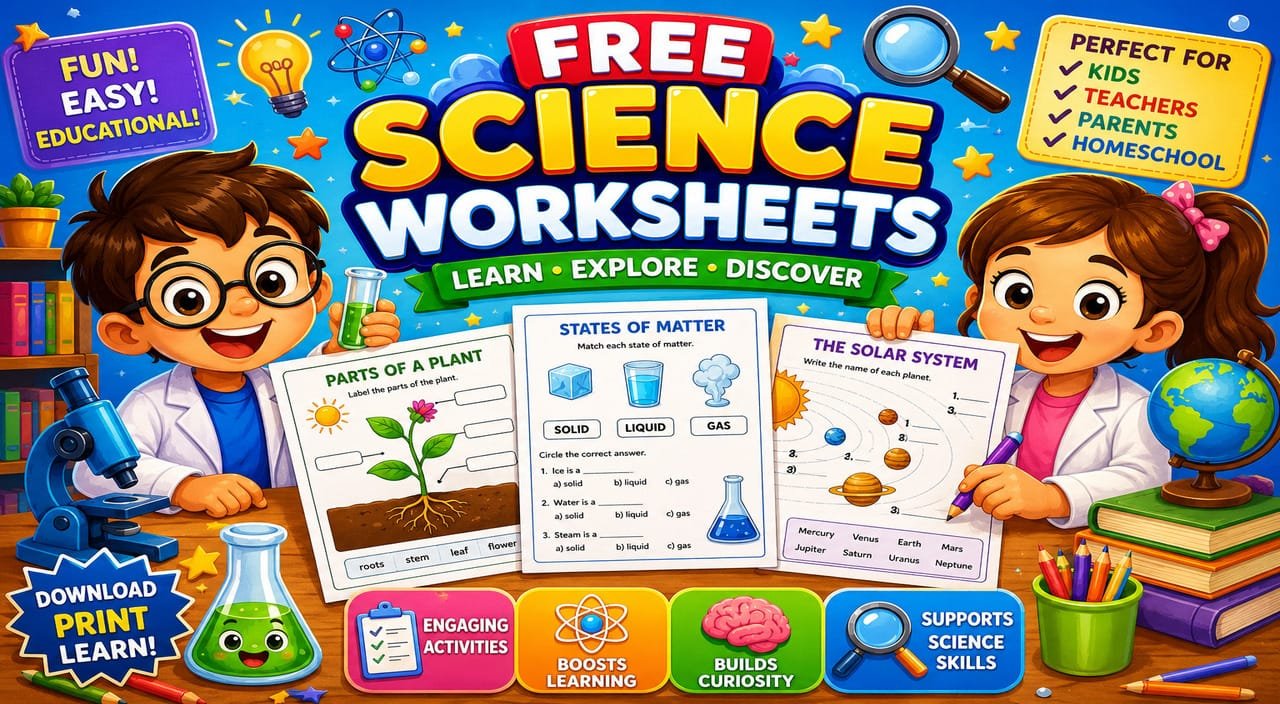
Free science worksheets for kids are printable learning sheets that feature subjects such as plants, weather, simple machines, and the human body.
They get kids reading, drawing, and hands-on experimenting with concise instructions and illustrations. Several sets correspond to grade levels and include metric measurements.
Parents and teachers utilize them to develop skills, measure progress, and bring lessons to life. Below are sources, tips, and sample activities.
Key Takeaways
- Worksheets take learning beyond memorization by provoking curiosity, directing experiments, and assisting kids in applying science to real-world scenarios. Let them help you foster problem-solving and analytical skills via diversified challenges.
- Sequence activities to scaffold concepts with vocabulary practice and step-by-step experiment sheets so kids gain confidence as ideas become more complex.
- Add in some open-ended questions, data interpretation, and scenario-based problems to build critical thinking and scientific literacy. Include group discussion and clear written communication.
- Incorporate charts, graphs, and recording sheets to teach data interpretation. Sprinkle in hands-on elements such as cut-and-paste or model building to nurture fine motor development and sensory engagement.
- Differentiated worksheets for diverse learners provide multiple formats, sensory and visual supports, and kinesthetic options for inclusive, accessible learning at all grade levels.
- Blend digital and print resources to balance interactivity and convenience with tangible, low-tech activities. Align worksheets with curriculum goals and use them for instruction, assessment, and follow-up projects.
Beyond Rote Learning
To go beyond rote learning is to move past memorizing facts to constructing durable understanding and the ability to transfer scientific concepts to new contexts. Free science worksheets come in handy when they are crafted to ignite inquiry, direct hands-on work, and relate concepts to real life, instead of merely requesting definitions.
1. Conceptual Scaffolding
Start with plain pages that identify components and illustrate fundamental processes, then augment with tasks that have students use those components in a mini experiment. Sequence a series of worksheets so one page reviews terms, the next has students label diagrams, and the third provides a step-by-step experiment sheet to test a prediction.
Vocabulary boxes and matching labels assist early learners in becoming confident, and transparent experiment directions allow children to practice observing and recording. For instance, a plant unit begins with leaf diagrams, advances to a cut-and-paste life cycle wheel, and concludes with a guided seed-growing sheet that measures height in centimeters.
2. Critical Thinking
Incorporate open-ended prompts that ask learners to describe why results vary or how to make a test better. Worksheets that have students compare two elementary experiments or classify observations as cause and effect challenge them to evaluate evidence.
Working in groups on shared sheets allows students to compare interpretations and improve their ideas through discussion. Scenario sheets, like selecting the optimal material to insulate a small model house, have students plan, test, and defend decisions, developing actual decision-making skills.
3. Scientific Literacy
Employ brief, worksheet-tied readings to develop both scientific understanding and literacy ability. Questions that request students to summarize findings, cite evidence from a short article, or write a brief lab conclusion make them practice clear science communication.
Aligning sheets with common standards guarantees that students are covering key skills. Real-world examples, such as news clippings about the weather or brief local habitat profiles, enable students to understand why the information is relevant and how to teach it to someone else.
4. Data Interpretation
Instead of just rote learning, give tables, simple graphs, and charts with prompts that they read and state what trends or anomalies they see. This could include graphing daily temperature, comparing growth rates, or reading life-cycle tables.
Provide students with recording sheets to record their measurements in centimeters or milliliters, then pose focused questions that require them to draw conclusions from this data set. These assignments instruct you on interpretation, not rote transcription.
5. Fine Motor Skills
Short cut-and-paste pages, coloring in diagrams, and label exercises fuse motor practice with conceptual learning. Life cycle wheels and plant sort projects incorporate scissor, glue, and crayon skills while reinforcing sequence and structure.
For lower grades, combine basic observation lists with sketching activities to connect observation, documentation, and hand coordination.
Worksheet Topics
Our science worksheets for kids span life science, earth science, and physical science topics. They’re for K to grade 3 and are aligned to grade-level expectations and common standards. Materials should include clear learning goals, scaffolding for skills, and varied formats: cut-and-paste, labeling, short answer, and simple data charts.
Topics are updated regularly to keep them fresh and to reflect new findings and timely themes, such as [insert basic space exploration] or [new environmental events].
Life Science
Worksheets in life science encompass animal life cycles, plant growth, genetics, habitats, and the five senses. Life-cycle sheets for butterflies, frogs, and mealworms include sequence boxes, drawing prompts, and short observation logs so students can record change over days or weeks.
Include human body pages that label major systems and explain basic functions with picture cues for the heart, lungs, digestion, and senses: sight, touch, hearing, smell, and taste. Provide worksheets such as mealworm observation logs or owl pellet dissection guides with safety tips and illustrated instructions.
Printable models and scavenger hunts immerse students in biodiversity and ecosystems. A backyard scavenger hunt that requests plants, insects, and hints of animal homes, for instance, develops observation skills and local context.
Earth Science
Earth science worksheets should include rocks and landforms, volcanoes, the water cycle, weather, and seasons. Use map-based tasks and earth-layer diagrams to teach spatial thinking.
Create a simple activity where students color crust, mantle, and core and match characteristics. Add seasonal charts and weather trackers for daily entries. Students can graph temperature changes over the course of a week, for example.
Include eco-impact worksheets with basic questions about recycling or water conservation to connect science to stewardship. Classroom scavenger hunts and habitat worksheets tie abstract concepts to the surrounding natural world.
Outer space pages spark curiosity about the moon, planets, and stars with kid-friendly illustrations and matching exercises.
Physical Science
Physical science includes matter, energy, motion, simple circuits, and basic chemistry. Solids, liquids, and gases worksheets with sort and real-life examples.
Add experiment sheets for forces, motion, and electricity detailing materials, safety procedures, and prediction questions. Include basic circuit templates where they connect the dots and find battery and bulb placement.
Provide practice on simple machines and the six basic types with pictures and examples from real life, such as seesaws, ramps, pulleys, levers, screws, and wheel-and-axles.
Periodic table and chemistry exercises in point form:
- Match element symbols to common uses
- Identify states of simple substances (water, oxygen)
- Count atoms in basic molecules
- Color-code metals vs nonmetals
- Simple pH ideas using household items
Effective Implementation
Free science worksheets can be used effectively with a plan that connects the tasks to learning objectives and classroom reality. Worksheets work best when combined with hands-on activity and simple directions. They provide structure, allow students to log information, and facilitate incremental experiments that develop scientific skills.
Tie worksheets to NGSS standards, connect worksheets to what students already know, and select worksheets that encourage students to predict, observe, and reflect.
Before The Worksheet
Prepare students by reviewing key ideas and vocabulary that appear on the worksheet. Briefly revisit prior lessons or show a quick demo so students can link new tasks to familiar concepts. Set clear objectives and tell students what success looks like for that session.
State whether the sheet measures skill, knowledge, or both. Organize supplies in advance — pencils, scissors, timers, measuring tools, and any simple lab items — so activity time stays focused and safe. Use a short list of rules for handling materials and a clear procedure sheet for experiments, which promotes careful planning and accurate data collection.
| Motivation strategy | Benefit |
|---|---|
| Choice of topic | Increases engagement and relevance |
| Gamified scoring | Encourages effort and friendly competition |
| Praise for process | Builds persistence and risk-taking |
| Real-world link | Shows practical use and boosts meaning |
During The Worksheet
Track progress and intervene with targeted questions when students stall. Circulate, observe notebooks, and encourage thinking, not answers. Have students explain predictions or methods.
Promote pair or small-group work where peers verify each other’s observations and exchange methods. Ask questions and let students note observations on the worksheet or on separate data sheets. This encourages clear recording and subsequent analysis.
Execute quick demos whenever a concept gets tricky, then have students redo steps themselves. These moves keep things interesting, aid retention, and foster skill development.
After The Worksheet
Review answers together to correct misconceptions and celebrate accurate thinking. Use completed worksheets as assessment tools and note which skills need reteaching and where students showed strong reasoning.
Assign follow-up tasks like a short experiment, a small research task, or a design challenge that grows ideas from the worksheet into deeper inquiry. Give timely feedback that points to next steps and ties back to objectives and standards.
Encourage reflection by asking students how the activity links to real life and what they would change if they ran the experiment again.
Adapting For Learners
Adapting free science worksheets is modifying difficulty, format, and supports so that all children can access and respond to the concepts. For instance, begin providing multiple options of the same activity: easy text, advanced challenge questions, and a visual-only version to accommodate different reading levels and attention spans.
Adapt for students by using student feedback to polish wording, assignment length, and the types of prompts that are most effective for your class or online community.
Sensory Learners
Craft worksheets that refer to activities and sensory audits. Add a page listing simple materials: real leaves, spoons, small cups, scented herbs or fruit peels, a ruler, and a magnifying lens. Provide directions for a brief scent test and leaf-feel sort, then have students note differences in a table or with a few words.
Add a directed experiment. Have students feel soil, measure moisture, and observe changes. This encourages slow, repeated practice and assists kinesthetic learners.
Offer object-sorting tasks tied to a printable sheet: match textures to terms like rough, smooth, and porous. Use short prompts: “Touch each sample. Circle the correct word.” For classrooms with limited resources, suggest alternatives: textured fabric, paper samples, or photos with close-up texture shots.
Let the tasks be processed on demand so students can repeat phases at their own convenience.
Visual Learners
Give diagrams and labeled charts that divide steps into distinct parts. Use a printable solar system with planets to color and affix onto a poster, along with a sheet that has easy labels and room for students to sketch out one fact about each planet.
Provide graphic organizers, such as Venn diagrams for animal comparisons and flow charts for life cycles, that allow students to insert pictures and brief annotations instead of complete sentences.
Add printables and cut-outs so students can make a heart or volcano model and then respond to 2 short questions. Have students design their own posters or science idea comic strips.
It tests understanding and generates a visual study tool they can take with them. Use larger fonts and high-contrast images for those requiring visual access supports.
Kinesthetic Learners
Build movement into worksheets with tasks like a scavenger hunt list tied to a recording sheet: find three different leaves, measure lengths, and then paste or draw them. Turn role-playing exercises into having students play out the water cycle while classmates tick off stages on a worksheet.
Incorporate cut-and-paste sorting activities, such as developing a food chain from illustrated cards and arranging them sequentially. Include short labs with clear steps and timing suggestions so students can manage their pace.
Allow physical demonstration as assessment: instead of a written answer, students can show how a seed germinates using props or a timed animation they build. Feedback from these activities helps teachers adjust difficulty and offers quick, practical checks on who needs more support.
Grade-Specific Focus
Science education should take students where they are. Customize worksheets to align with developmental stages and curriculum standards for each grade, providing a well-defined progression from informal observation to formalized investigation. With KG-to-5th-grade printable worksheets that lay the groundwork, such as life cycles, senses, simple machines, and earth science, set your student up for more concentrated work in middle school.
Grade-specific focus facilitates continuous learning by providing age-appropriate activities, increasing difficulty and depth steadily, and associating tasks with quantifiable standards.
Kindergarten
- Sort pictures of animals by habitat.
- Match leaves to seasons and color-code changes.
- Have them count seeds and graph how many are in each packet.
- Trace and label the five senses with simple icons.
- Plant a bean in a cup and number each day’s growth.
- Match pictures of life cycle stages (butterfly, frog).
- Identify weather types and circle the day’s weather.
- Use stickers to sequence daily routines: morning, noon, night.
- Explore textures: touch samples and record soft/rough.
- Play a sound game: listen and match the source.
Present seasons, senses, and plant growth with big pictures and small text to maintain focus. Hands-on activities, such as planting beans, sorting leaves, and sound games, make the abstract concept become concrete experiences.
Worksheets should link basic math and literacy by counting seeds, tracing words like “leaf” or “sun,” and simple graphing. Its transparent design, striking illustrations, and single-step instructions help preschoolers thrive and delight in science.
5th Grade
Give your students a challenge with ecosystems, energy transfer, and scientific inquiry. Provide experiment recording sheets that query the hypothesis, variables, procedure, and observations. Then, offer data interpretation problems where students read tables or graphs and draw conclusions.
Ask critical-thinking questions that demand a written explanation. For example, have students justify their methods or evaluate results. Align materials with standardized test prep and common science standards by including practice items on layers of the Earth, light energy, and solar system concepts.
Offer independent research tasks: short projects on cells or human body systems with prompts for sources, note-taking templates, and rubric-based self-assessment. Add timed drills for vocabulary, word problems integrating math, and multi-step labs to develop analysis skills.
Worksheets should be printable, scaffolded, and adaptable for group or solo work, preparing students for middle school depth and inquiry.
Digital And Print
Free science worksheets for kids come in digital and print versions. Each offers different advantages that influence the learning styles of students and the instruction of teachers. Below, we’ve enumerated the benefits so teachers and parents can select or mix and match formats to suit curriculum objectives, classroom limitations, and student desires.
Digital Advantages
Digital worksheets provide immediate access to the entire resource and printable versions. A teacher anywhere can bring up lab sheets, diagrams, or even swift quizzes in seconds; share links with students; or print as needed for hands-on work.
Some instructors use digital collections to supplement lesson plans and to update materials for shifting standards or emerging topics. Interactive elements enhance the experience beyond the flat pages.
Embedded videos that teach how evaporation works, built-in quizzes that grade responses, and auto-grading that saves time allow for easy immediate feedback and progress monitoring across a class or online tutoring session. Tutors can assign tasks, review answers live, and adjust lessons according to data.
Remote learning and tutoring flow smoothly with digital files. Students fill out worksheets during live video sessions or as homework on phones, tablets, or laptops.
This facilitates learning anywhere and extends to learners without consistent physical access to school materials. Customization and frequent updates are feasible with digital formats.
Teachers can modify copy, exchange photos, or localize measurements in metric. Digital worksheets work perfectly for differentiated instruction because a teacher can make multiple versions of the same activity at different levels.
Print Advantages
Printed worksheets provide that tactile feel that fosters fine motor practice and handwriting. Younger students enjoy the tracing, cutting, and pasting activities that supplement concepts as they build control.
Print cuts down on screen time and avoids tech obstacles. In low-device or flaky-internet environments, a pile of printouts keeps your lessons progressing. Libraries and community centers rely on print for wide, low-tech accessibility.
Annotation and tactile interaction are still simpler on paper for many. Kids can annotate diagrams, color-code portions of a plant, or draw observations of a simple experiment.
Others learn by reading and memorizing, and they swear by paper, where print remains an excellent option for taking and reviewing notes. Printed materials work across settings: classroom centers, home study, or hands-on science stations.
They complement digital lessons nicely, providing either pre-lab or after-lab practice.
| Advantage | Digital | |
|---|---|---|
| Instant updates | Yes | No |
| Interactive feedback | Yes | No |
| Fine motor practice | No | Yes |
| Works offline | Limited | Yes |
| Easy to share remotely | Yes | Limited |
| Better for note-taking (some) | Mixed | Yes |
Combine both formats to build a complete toolkit: use digital for assessments and video demos and print for hands-on practice and retention.
Conclusion
Free science worksheets deliver obvious victories for kids. Bring concepts to life with hands-on activities, mini-experiments, and easy charts. A second grader can follow the water cycle with a cut-and-paste page. A middle schooler can test pH with kitchen items and log results in a neat table. These sheets pack small lessons, home projects, or quick classroom checks. Use them to cultivate wonder, not merely information. Match the sheet to the child’s skill and give one clear goal per page. Switch the paper and tablet, respectively. Keep tabs on progress with a couple quick notes. Begin with little, observe curiosity swelling, and maintain the tasks brief and functional. Give a set a try this week and see what style clicks.
Frequently Asked Questions
What age range do free science worksheets typically cover?
Free science worksheets for kids of all ages. There are worksheets for preschool, elementary, middle, and even a few high school topics. Watch for age and grade labels to align with developmental needs.
Are free science worksheets high-quality and trustworthy?
There are tons. Most are great, particularly those from schools, museums, or educational nonprofits. Verify author credentials, curriculum alignment, and user reviews prior to use.
How can I use worksheets without promoting rote learning?
Pair worksheets with hands-on activities, discussions, and experiments. Utilize them to practice, evaluate, or guide inquiry, not as the only teaching tool.
Can I adapt worksheets for different learners?
Yes. Simplify language, add visuals, extend challenge questions, or provide step-by-step supports. Differentiation makes worksheets flexible for multiple levels and skills.
Which topics are most common in free science worksheets?
Popular subjects are life science, physical science, earth science, and simple experiments. The collection includes worksheets on ecosystems, forces, weather, and the scientific method.
Are printable worksheets better than digital ones?
Both are advantages. Printables play nicely with hands-on activities and low-tech environments. Digital worksheets provide interactivity and instant feedback. Select according to availability and educational objectives.
Where can I find reputable free science worksheets?
Begin with schools, government education sites, science museums, and trusted nonprofits. These are often standards aligned with teacher notes.