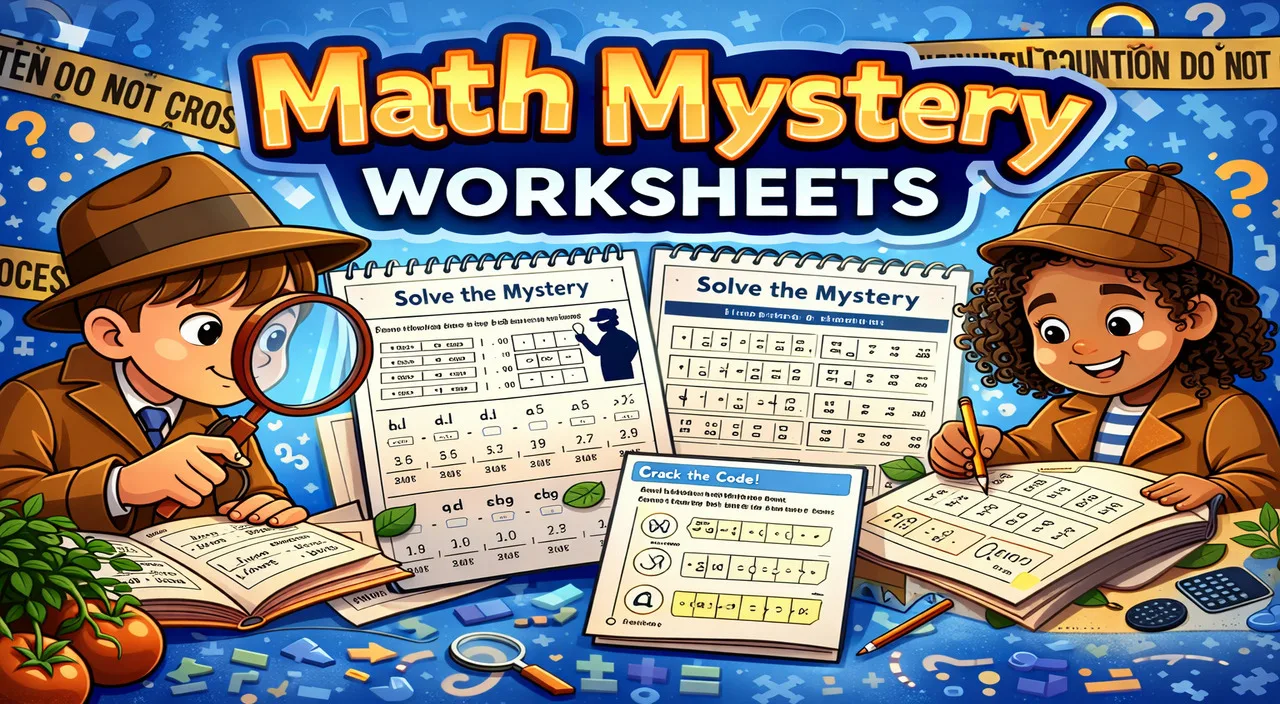
Math mystery worksheets add fun to math practice by combining logic puzzles and clue solving with practice problems. When students solve math steps to unlock answers, every assignment is an adventure.
Educators rely on these sheets to jumpstart problem-solving skills and keep lectures vibrant. Worksheets suit a wide range of abilities and can be used in class or at home.
Next, find out how to select quality ones and test what works for you.
Key Takeaways
- Math mystery worksheets encourage mental flexibility and frustration tolerance by stimulating students with fun analytical puzzles and reinforcing persistence.
- The real-world and cross-curricular themes within math mysteries further reinforce conceptual understanding and the practical relevance of mathematical skills.
- Collaborative logic comes into play as students collaborate in teams, strategize together, and divide up the problem-solving. This provides those key communication and teamwork skills.
- By varying the difficulty of the math mystery worksheets and offering different activity options, you can meet the needs of all your students, no matter their skill level.
- Effective implementation requires clear learning objectives, flexible grouping, ongoing assessment, and scaffolding techniques to guide and monitor student progress for optimal learning outcomes.
- Combining digital tools with student-generated math mysteries promotes creativity, engagement, and cultivates technical and analytical skills for a lifetime.
Unlocking Potential
Unlocking potential for math education is about more than just learning equations. Developing thinking skills, emotional resilience, and a feeling of practical application is essential. Math mystery worksheets provide students with an opportunity to step outside their comfort zones, challenge themselves, and collaborate.
These types of tasks assist students in developing by mixing difficulty, enjoyment, and collaboration. A supportive classroom allows students to take small risks, experiment with new strategies, and reflect on their progress. Gradually, they develop a growth mindset and uncover abilities they never thought they possessed.
1. Cognitive Agility
Timed math mystery tasks cultivate quick thinking and focus. As students race to beat the clock and solve clues, they learn to think on their feet and react quickly. Pattern puzzles urge them to identify connections, such as observing how a series extends or how digits change.
By mixing problems, for example, using both addition and multiplication, students learn to change gears without losing accuracy. Every new challenge brings a new twist, so being mentally flexible is the name of the game. The random content ensures that no two worksheets ever have the same ‘feel’, keeping little minds sharp and interested.
2. Emotional Resilience
Solving hard puzzles boosts self-belief. When students crack a difficult question even after many attempts, they begin to believe in their own abilities. Frustration is in the mix, and learning when to take a break, when to try again, or when to ask for help shows them how to navigate and develop.
A few classes utilize printable awards, which encourage and recognize hard work. Mistakes are not failures; they are learning steps, and a nurturing classroom creates the safety to try, fail, and try again. Recent research shows that this slow, steady path helps learners see growth as a journey.
3. Conceptual Links
Math mystery worksheets frequently have a narrative or relate to real-world events. For instance, a worksheet might use a mystery in a city market, demonstrating how math assists people in making change or dividing up produce. Others mix in some history, such as the ancient number systems, or science, like measuring distance or speed.
Making the connection between math and these themes helps students visualize how math reflects the world surrounding them. They even begin to connect various math concepts, such as the relationship between fractions and percentages.
4. Collaborative Logic
Group work is the key in lots of math mysteries. When students share ideas, they learn from one another and glimpse new ways to crack the problems. Others assign each student a responsibility, such as note-taker, checker, or clue reader, to ensure every voice is heard.
Teams frequently crack bigger puzzles more quickly than individuals as they pool skills and strategies. Class competitions are fun too, adding a little extra challenge and pushing teams to collaborate and think on their feet.
5. Sustained Focus
Compelling narratives hold student attention from beginning to end. Worksheets that intermixed easy and hard tasks kept everyone challenged. Short breaks, games, or a quick stretch can recharge focus if a session drags.
Bright images or mystery pictures assist students to remember and like the lesson. By intermingling projects and instruments, educators maintain concentration and keep minds engaged.
Effective Implementation
Math mystery worksheets can assist students in improving their math abilities in an entertaining, captivating manner. When used properly, these exercises accommodate a variety of classroom environments, including math centers, group or partner work, reviews at the end of the week, or even homework.
The trick is to have goals for what you want each worksheet to help students practice or review. Educators should choose if the emphasis is on review of fundamental concepts, exposure to new concepts, or just making math practice fun. Being clear about these goals informs how the activity gets deployed and how its success is measured.
Numbered steps for effective use:
- Decide what you want to achieve with each worksheet. For example, brush up on fractions or practice multiplication.
- Select the worksheet style that best suits your class: entire packet for work in class or individual clues homework for practice.
- Provide the students with specific directions and a setup that defines the riddle to crack.
- Implement well. Use visual aids or graphic organizers so students can keep track of clues and organize their thoughts.
- Cohort students by skill level or style of learning, exchanging clues or packets as appropriate.
- Track how students are doing, provide hints when appropriate, and adapt your next steps based on student responses.
- Wrap up with a review or discussion. Have students discuss strategies and reflect on what they learned.
Flexible grouping is at the heart of accommodating all types of learners. Teachers could potentially hook students with varying strengths together or group them into small groups by ability. In other cases, students can work individually for a self-directed challenge.
Mixing up the format and groupings keeps students engaged and guarantees everyone receives the appropriate level of support. Tracking progress is more than just scoring responses. Teachers can gather student work to identify what requires further review or determine which strategies work best.
This feedback loop refines not only the activity but the instruction as a whole. Math mysteries — used as a supplement, not a replacement, to regular lessons — provide students with repeated exposure to key concepts for a more thorough understanding.
Scaffolding
Begin with easy problems to give your students confidence before working up to harder enigmas. Guided practice lets students test new skills with teacher assistance, and visual supports like charts or graphic organizers simplify categorizing clues and following your thinking.
Feedback along the way is key, whether it’s fixing an error or proposing a new technique. This gets students away from simple memorization and into true reasoning, which makes math less frightening.
Differentiation
| Grade Level | Complexity Adjustments |
|---|---|
| Early Primary | Simple clues, basic addition/subtraction, visual supports |
| Upper Primary | Multi-step problems, reasoning tasks, modest complexity |
| Lower Secondary | Abstract concepts, flexible thinking, integrated topics |
| Upper Secondary | Advanced algebra, layered clues, open-ended solutions |
Providing options—theme, format, or online versus print—allows students to select what intrigues them. Educators can increase or decrease the challenge by swapping out clues, using grade-level packets, or adding assistive technology.
For example, a digital equivalent could contain clues or other interactive supports for struggling students, broadening the worksheet’s appeal.
Assessment
Formative checks, such as quick quizzes or exit slips, help gauge understanding before moving on. Assessment rubrics clarify expectations and make grading fair.
| Criteria | Excellent | Satisfactory | Needs Improvement |
|---|---|---|---|
| Problem Solving | Accurate, well explained | Mostly correct | Lacks clarity |
| Reasoning | Strong logic, clear steps | Some errors | Limited evidence |
| Collaboration | Active, constructive | Participates | Minimal input |
| Completion | All clues attempted | Most completed | Incomplete |
Self-reflection tools empower students to take ownership of their progress. Teachers collect data over time to recognize progress and focus assistance.
Regularly reviewing math mysteries keeps learning fresh and gives teachers a transparent window into student strengths and needs.
Anatomy of Engagement
Math mystery worksheets engage kids by turning math into more than just numbers and symbols. Storylines, puzzles, and rewards combine so students feel accomplished, competent, and excited to participate.
These worksheets leverage choice, collaboration, and visual aids to increase engagement, assist students in developing math skills, and accommodate all learning styles.
The Narrative
- An ancient relic disappears from a museum and you can only crack the thief’s identity through math clues.
- Students accompany an eccentric detective with peculiar abilities who requires assistance deciphering a secret code embedded in equations.
- A time-traveling mathematician is lost somewhere in history, and the class has to solve puzzles from every century to bring them back.
- A nefarious supervillain menaces a city’s power grid. Math riddles hidden in blueprints show you how to get the power back on.
- A local sports team’s mascot is swiped before the big game, with the perpetrator depositing math-themed hints throughout the city.
By putting the students in the role of a super bad superhero or clever detective, students can more easily identify themselves in the problem and inject some humor.
Stories that end on cliffhangers, such as a locked room or a missing piece, make students want to continue to discover what happens next. These stories are most fun when students generate their own endings or new mysteries, making math personal and nurturing creativity.
The Puzzle
Great math mysteries combine good logic and puzzle solving and an interesting mix of math skills. Puzzles work best when they employ word problems, equations, or even riddles, so students have to think differently.
By making what would otherwise be a rote worksheet more visual, such as mystery pictures that unveil a clue after each correct answer, the worksheet becomes game-like and engages students who wouldn’t connect with numbers.
Short and long puzzles can be interspersed. You might have students decode a message using prime numbers, while another could be more like a ‘match these graphs to the suspect clues.’
Having students work in pairs or small teams introduces a social component, where they can teach one another and discuss various strategies. It allows students of varying abilities the opportunity to assist one another and feel a part of the group.
The Reward
- Digital badges for solving a set of mysteries
- Fun physical prizes (stickers, bookmarks, or classroom privileges)
- Certificates for teamwork, creativity, or persistence
- Displaying solutions on a class board or online gallery
Printable certificates or digital awards make students proud of their work. Group prizes, such as posting solutions for the class, foster a community feeling and demonstrate that collaboration is appreciated.
Students are able to create their own objectives, such as reading through three mysteries within the month, and rejoice when they accomplish them. By sharing solutions and strategies, students learn from each other and gain confidence.
Beyond the Classroom
Taking math mystery worksheets outside of the classroom gives them new meaning. These activities aren’t just to fill class time; they help students relate math concepts to real life, ignite excitement around STEM, and develop authentic skills for the working world. Math mysteries, online or printable, can meet the needs of various ages and skill levels, making them a convenient selection for educators and students alike.
Real-World Logic
Crafting math mystery worksheets with real-world scenarios, like budgeting a community event or planning travel, demonstrates to students how numbers come into play beyond the textbooks. For instance, a worksheet might have students design an imaginary festival, which makes them juggle costs of food, decor, and entertainment.
These assignments encourage students to apply math to problems that reflect what adults encounter, such as budgeting or planning group activities. Integrating case studies from engineering, healthcare, or finance adds depth and context. For instance, one worksheet could challenge students to examine data from a small business, seeing how changing prices or sales strategies might affect profits.
As they work through these puzzles, students begin to see the relevance of math in everyday decisions at work. These kinds of problems foster critical thinking because students aren’t just asked to find the correct answer, but to explain how and why. Math mysteries that utilize detective clues and sequential puzzles promote grit.
Students are inspired to persevere because every hint cracked is a step toward the answer. This fosters grit in tackling problems, something applicable to any profession.
STEM Mindset
Our beyond the classroom math mysteries with STEM focus assist students with connecting what they learn in math to broader fields. For example, a mystery worksheet might be an engineering challenge to build a bridge with constraints on materials that demands collaboration and ingenuity. These kinds of activities cultivate a growth mindset.
They demonstrate that errors are an avenue to learning and that persistence leads to breakthroughs. Discovery and experimentation are at the heart of STEM-inspired mysteries. Worksheets that are either open-ended or demand testing of different methods encourage innovation.
For instance, a puzzle on maximizing solar panel configurations merges geometry with physics and encourages students to test and adjust their solutions. These experiences emphasize how math intersects with science and technology and motivate students to envision themselves as contributors to the innovation of tomorrow.
Collaboration is another prime advantage. Many math mysteries are designed for group work, creatively building social skills and encouraging students to share strategies. This reflects how actual engineering or scientific teams work through issues collaboratively.
Digital Mysteries
Digital math mystery worksheets transform the student experience with tools that make learning a different kind of fun. These worksheets make math problems into fun, game-like puzzles, typically detective or CSI-themed. Through screens and apps, students interact with clues, categorize information and search for solutions in an environment that’s less assignment and more game.
The digital versions allow instructors to select from multiple themes and levels, so students of varied ages and abilities can participate and remain engaged. The math can vary from light math for younger students to more complex puzzling for older ones, so it will easily fit into many curriculums.
Most digital mysteries employ websites or apps to assist students in collaborating. In a virtual room, students can collaborate, exchange notes, and tackle larger issues collectively. This collaborative effort develops not only mathematical skills but social and communication skills.
Some worksheets allow individual students to work independently, but most are designed for teams, assisting students in learning how to exchange ideas and be attentive to others. These activities are not just about math. They can blend in reading and science, having students read stories, watch quick video hooks, or use science facts to crack the code.
That mix of skills results in new ways students are exercising their brains. Digital perks such as video hooks or interactive worksheets provide students with additional means to engage. Videos can establish the mystery or demonstrate the math challenge in action, making the challenge immediate and real.
Because the worksheets are interactive, students get to click, drag, or even type in their answers, keeping them engaged and involved. These exercises allow students to craft their own digital mysteries. By constructing their own puzzles, students employ both math and their creative instincts.
They can exchange these with fellow students, sharing insights and discovering fresh approaches to puzzle solutions. Digital mysteries can accommodate any classroom or home environment. They’re great for developing reading, reasoning, and math skills simultaneously.
Teachers and parents select worksheets that correspond to the student’s skill level and the topic they want to cover. The CSI/detective motifs provide a sense of adventure. Suddenly, solving problems becomes something students anticipate!
Create Your Own
Building math mystery worksheets from scratch puts students in the driver’s seat, allowing them to control the questions and the narrative. This ownership can increase commitment, which makes students more receptive to the material and more persevering. When they make their own puzzles, students get to interact with numbers and concepts in meaningful new ways, which can cultivate stronger connections to math skills.
Math mysteries give students a chance to think creatively, invent their own twists, and witness how math can mold into real-world tales. Not only is it fun to build your own, but it aids in helping students realize that math is more than right and wrong answers—it’s creative, too. Although this can be time consuming and sometimes things don’t work the first time, it means students learn to troubleshoot and iterate.
Every adjustment gets them to observe what succeeds, what fails, and how they can improve. Even if students hit bumps, those moments can end up teaching as much as the math itself. Templates and explicit steps assist students in molding their thoughts without wandering. For example, a worksheet template might start with a simple mystery story: “A missing gem has vanished from the museum,” and then guide students to build math questions that reveal clues.
Templates can have boxes for the story, space for math problems, and holes for clues or answers. By providing students with a framework, educators simplify initiation, especially for those who are lost staring at a blank sheet. Good heuristics remind students to tailor the math to their abilities and verify that each hint is reasonable. Templates can save time and reduce stress, allowing students to concentrate on the enjoyable aspects of constructing their enigma.
Tag teaming it can take off some of the pressure and make for more fun work. When students exchange ideas, they can identify issues, repair muddy hints, or inspire improved story turns. Groups can split up tasks: one might write the story, another might draft the math questions, and a third could check the answers.
This collaboration develops social skills and can help the work go quicker. As students assist each other, they discover how to catch each other’s mistakes, reason through problems, and receive feedback constructively. Even mistake-worrying students can relax when in a group because everyone offers their own unique contribution.
By sharing completed math mysteries with the class, the project becomes an authentic experience. Students take pride in exhibiting what they created, and classmates receive a new puzzle buffet to crack. This step lets us all see that there is not one right way to construct a math mystery; each one will be unique, molded by different minds.
Teachers can arrange for students to share their mysteries, discuss their takeaways, or maybe even vote for the most clever clue. These times foster community, allow students to learn from one another, and let them all shine.
Conclusion
Math mystery worksheets provide actual worth. They transform tough math tasks into bite-sized actions. Your students go from guesswork to genuine mastery. Teachers watch kids jump in and think hard. Online resources keep kids engaged and able to work independently. You can customize these sheets for any age or subject. Even when school is out, these keep math fresh and fun for kids. To construct your own, begin with transparent actions and concrete objectives. Experiment with new concepts and see what connects. Exchange hints or queries with other users of these sheets. To keep math vivid and vibrant, use tools that serve real purposes. For additional inspiration or assistance, connect or commiserate with colleagues.
Frequently Asked Questions
What are math mystery worksheets?
Math mystery worksheets are little problem-solving activities where students solve math problems to reveal clues and solve a “mystery.” They turn math into an engaging, interactive learning experience.
How do math mystery worksheets support student engagement?
They employ narrative and riddles to engage students. Kids become involved actors, turning math practice into a fun and unforgettable experience.
Can math mystery worksheets be used in digital classrooms?
Yes, lots of math mystery worksheets are available in virtual formats. They go great with online courseware and engage students across the globe!
Are math mystery worksheets suitable for all grade levels?
Indeed, math mystery worksheets are available for various ages and levels. They’re easily customizable for just about any math subject.
How can I create my own math mystery worksheet?
Begin by selecting a math topic and crafting a plot. Design questions that expose hints as students answer them. Take a few simple tools or templates to format your worksheet.
Do math mystery worksheets help with critical thinking?
Yes, they promote logical thinking and problem-solving. Using math skills to analyze clues and draw conclusions builds critical thinking skills.
Can these worksheets be used outside of math class?
Indeed, math mystery worksheets are great for at-home, after-school, or enrichment use. They provide learning outside the box.